

Tiered Pricing
This bills the price per unit in a tiered system. Unit price changes by tiers within each metering window; units in a higher tier are billed at that tier’s rate. Units will be charged differently depending on the tier they fall into. The tier is determined by the actual usage in a period. Usage accumulation is set to monthly by default.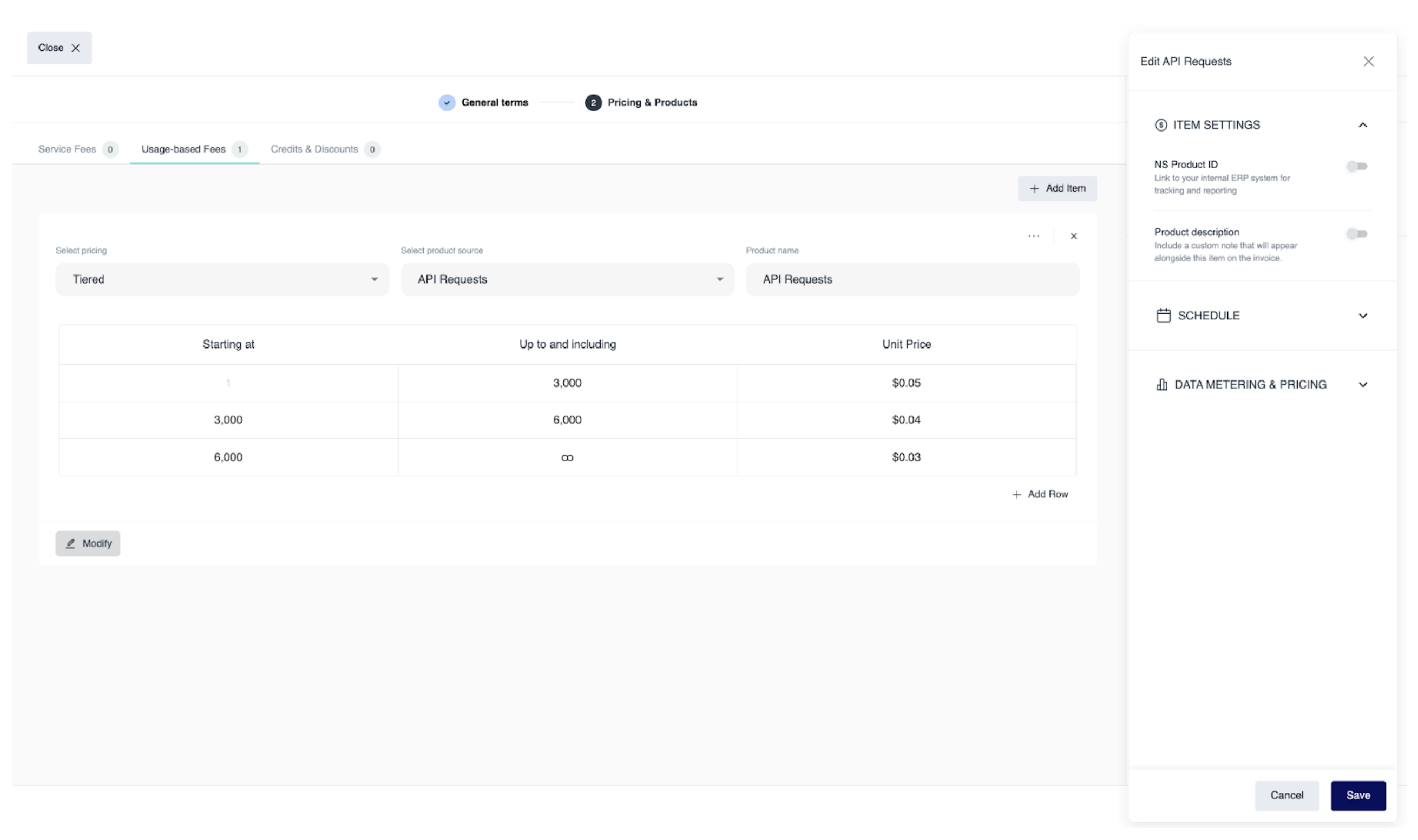

Metering vs. Billing
The billing Interval describes how often charges are billed (e.g., monthly, quarterly); it can differ from the metering window. On the other hand, the meter reset addresses the cadence at which metered usage counters reaggregate (e.g., monthly, quarterly, annually), independent of billing interval.
You can have different usage metering and billing intervals. For example, you can meter monthly but charge for overage quarterly.
The billing Interval describes how often charges are billed (e.g., monthly, quarterly); it can differ from the metering window. On the other hand, the meter reset addresses the cadence at which metered usage counters reaggregate (e.g., monthly, quarterly, annually), independent of billing interval.
You can have different usage metering and billing intervals. For example, you can meter monthly but charge for overage quarterly.
Volume Pricing
With volume-based pricing, the unit price is defined based on aggregated usage, with customers paying the base fee of their current tier. Discounts to a certain volume of usage will apply retroactively once that threshold is reached. For instance, The price per unit might be $.05, until you buy 2,000 of them, at which point each unit becomes $.04.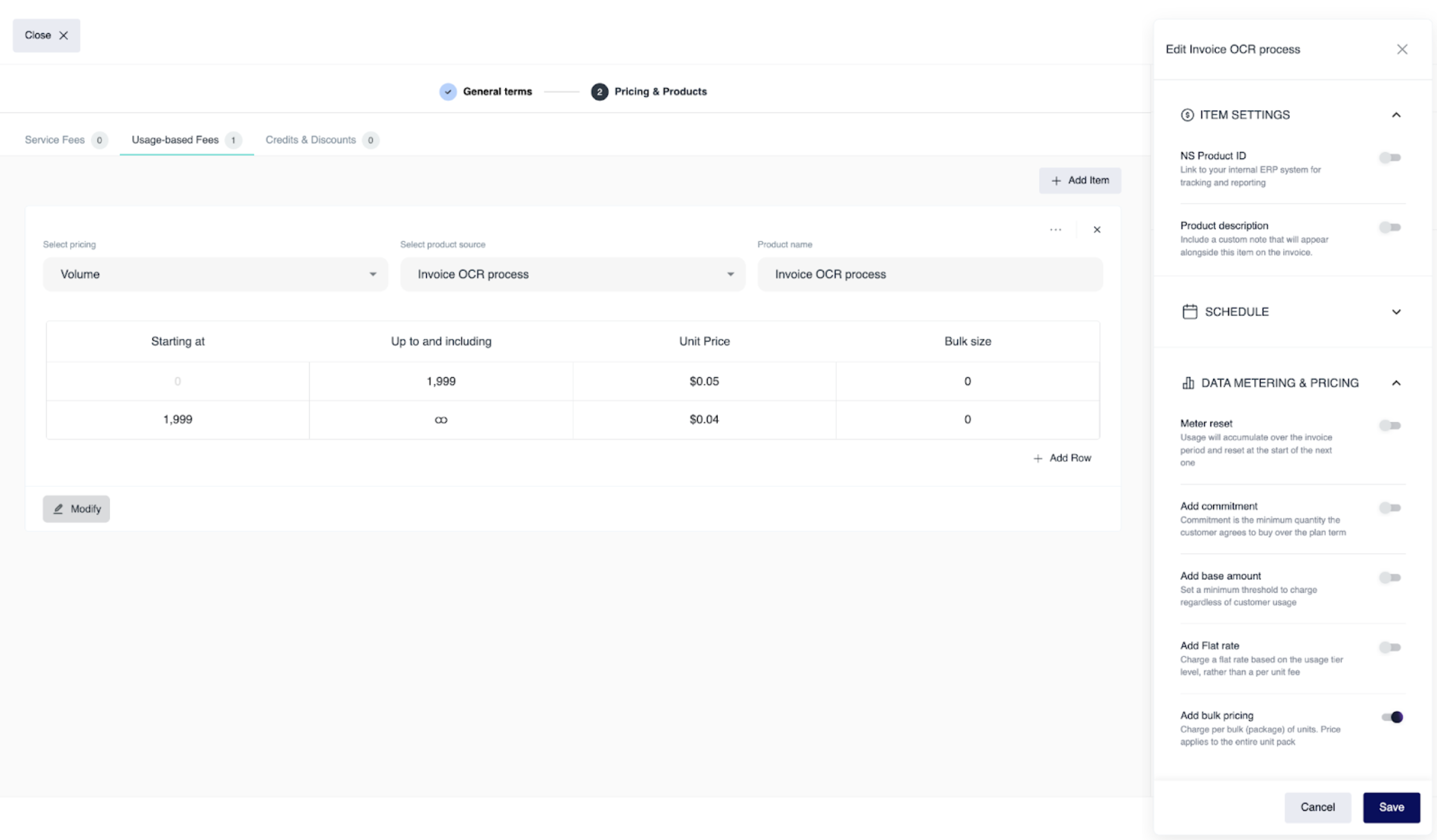
Usage accumulation is ‘lifetime’ from the contract start date. The charges are periodic and are based on the accumulative volume up until that point.
Per Unit Pricing
Per-Unit Pricing – A pricing method where each unit of usage is billed at a fixed, single rate. Every unit costs the same amount regardless of volume, tier, or lifetime consumption. Unlike tiered or volume pricing, the price does not change as usage increases.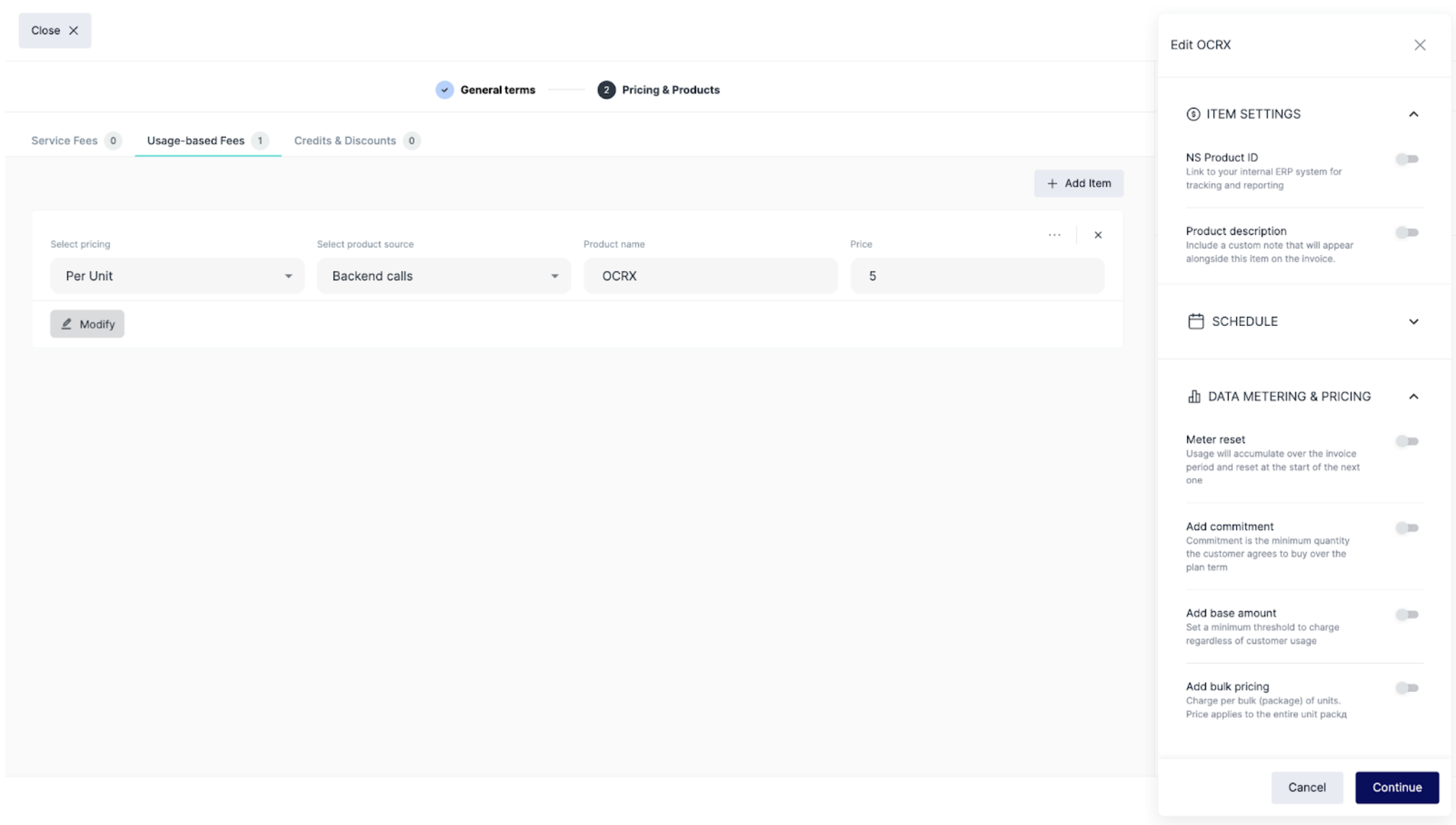
- Add Commitment – consumption limits, when the commitment is crossed, overage may be charged. you have the option to reset the commitment every chosen timeframe (monthly, bi-monthly, quarterly, semi-annually, annually)
- Add Base Amount – Minimum amount that will be charged regardless of consumption
- Add Bulk Pricing – A discounted price if a customer is buying a certain number of items, but the price applies to the entire package of units
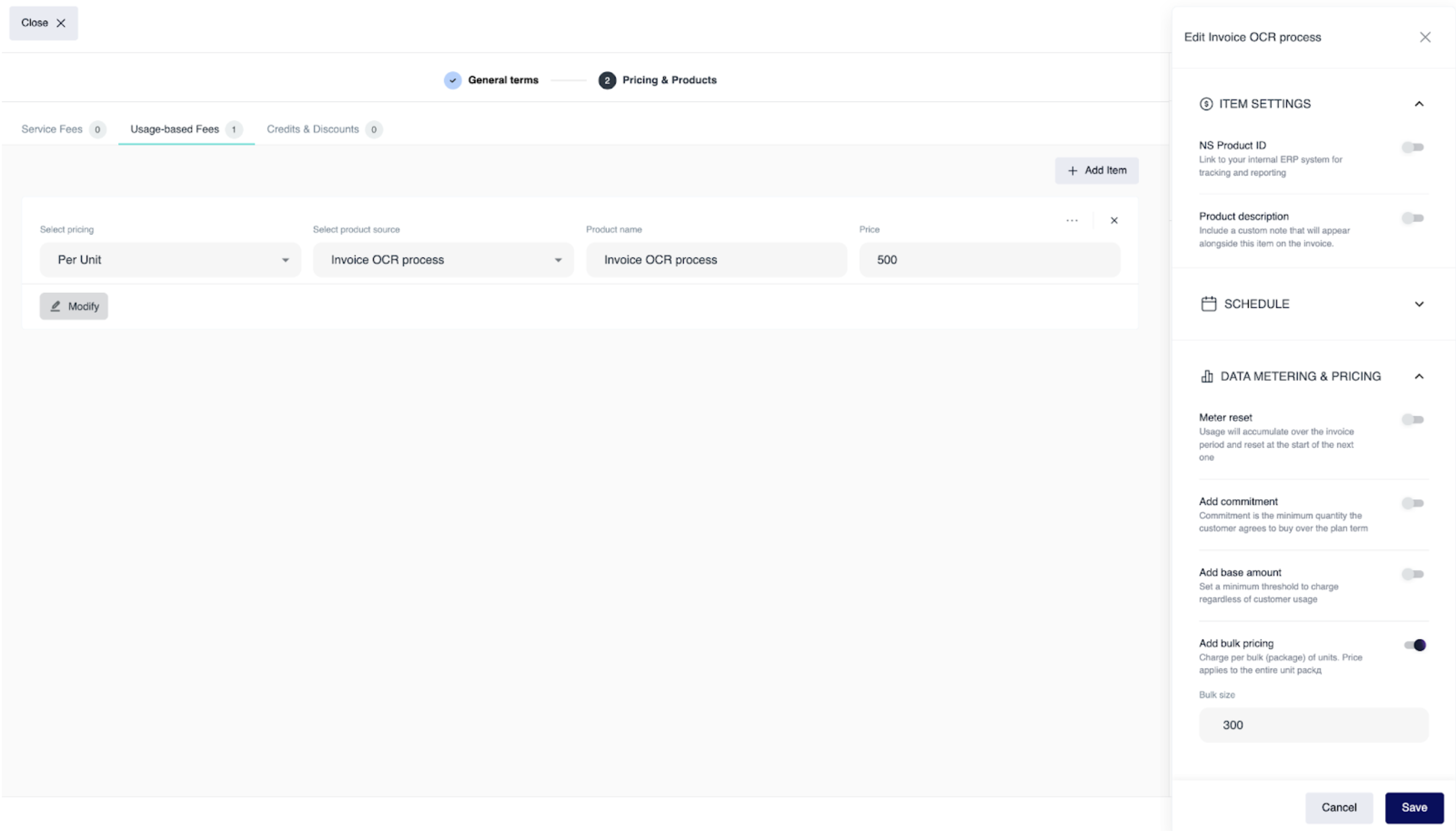
A commitment is the minimum quantity a customer has committed to consume during the plan or a specific reset at a given phase of the contract. The commitment can be either in ‘Units’ or based on a dedicated ‘Amount’ (USD).Base amounts are minimum thresholds to charge regardless of customer usage. They allow you to set a minimum amount to be charged in cases of zero consumption. This is only applicable for metered or usage-based products.
Tiered Subscription
For tiered subscriptions, a flat rate fee will apply based on the consumption in a tier for each billing period. By default, subscriptions will be upfront charges on a monthly basis. To edit a tiered subscription plan, hit Modify and you can edit the following variables:- Product ID
- Automatic Upgrade (yes/no) – Tier crossing is calculated pro rata based on the amount of time (number of days) spent in the new, higher tier. These overage charges will be charged along with prepayment for the next billing interval.
- Product Description
- Payment Schedule (upfront/postpaid, billing period, and billing interval) – Billing period refers to the term of the contract, while billing interval refers to how often billing occurs to pay for the period of the contract.
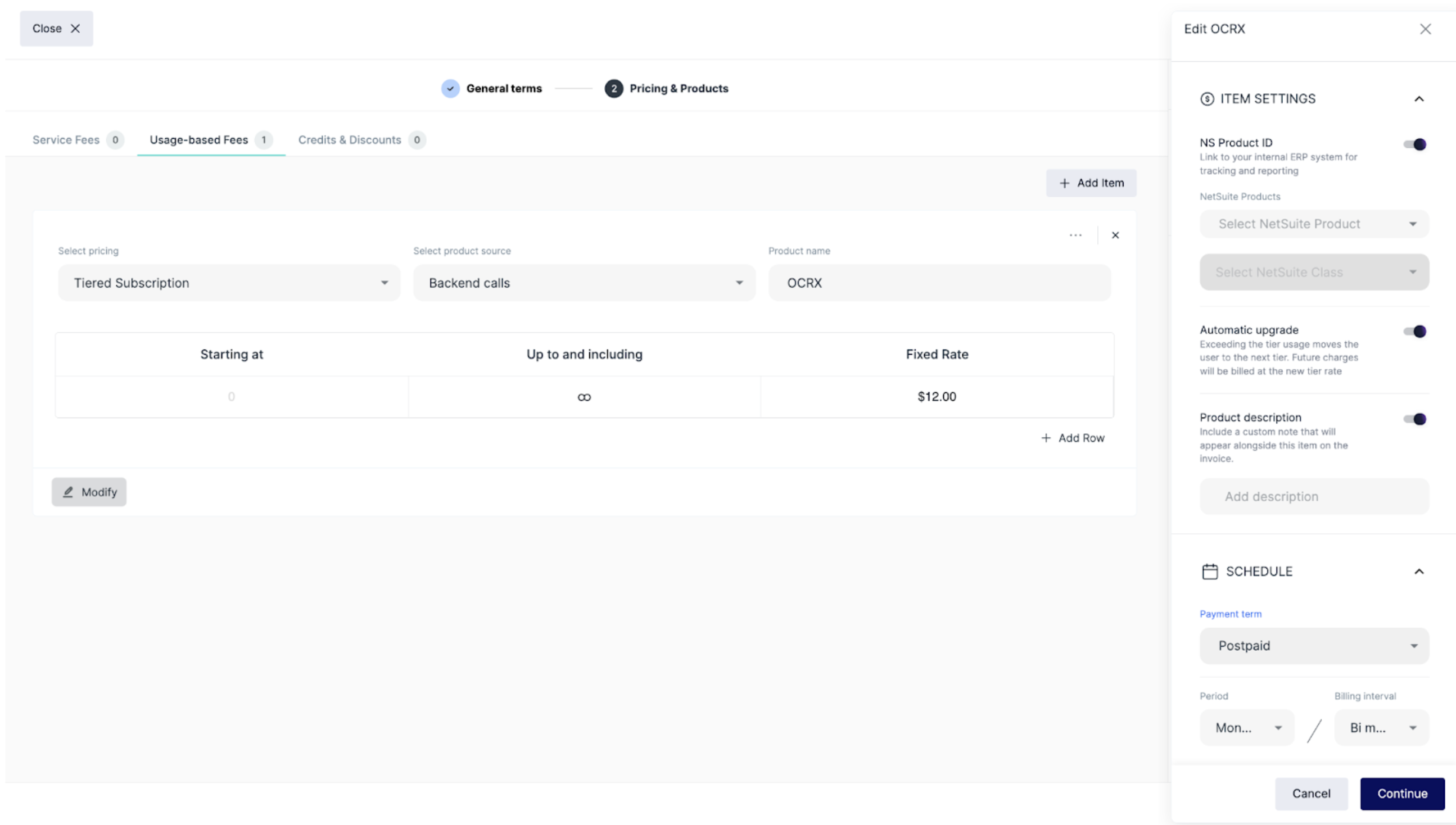
You can add the following enhanced pricing features to tier subscriptions:
- Auto-Upgrade – When a customer crosses a usage tier into a new tier, that customer is automatically upgraded to the new tier permanently
- Prepay – Collecting payment at the start of a chosen period for the upcoming service
Revenue Share
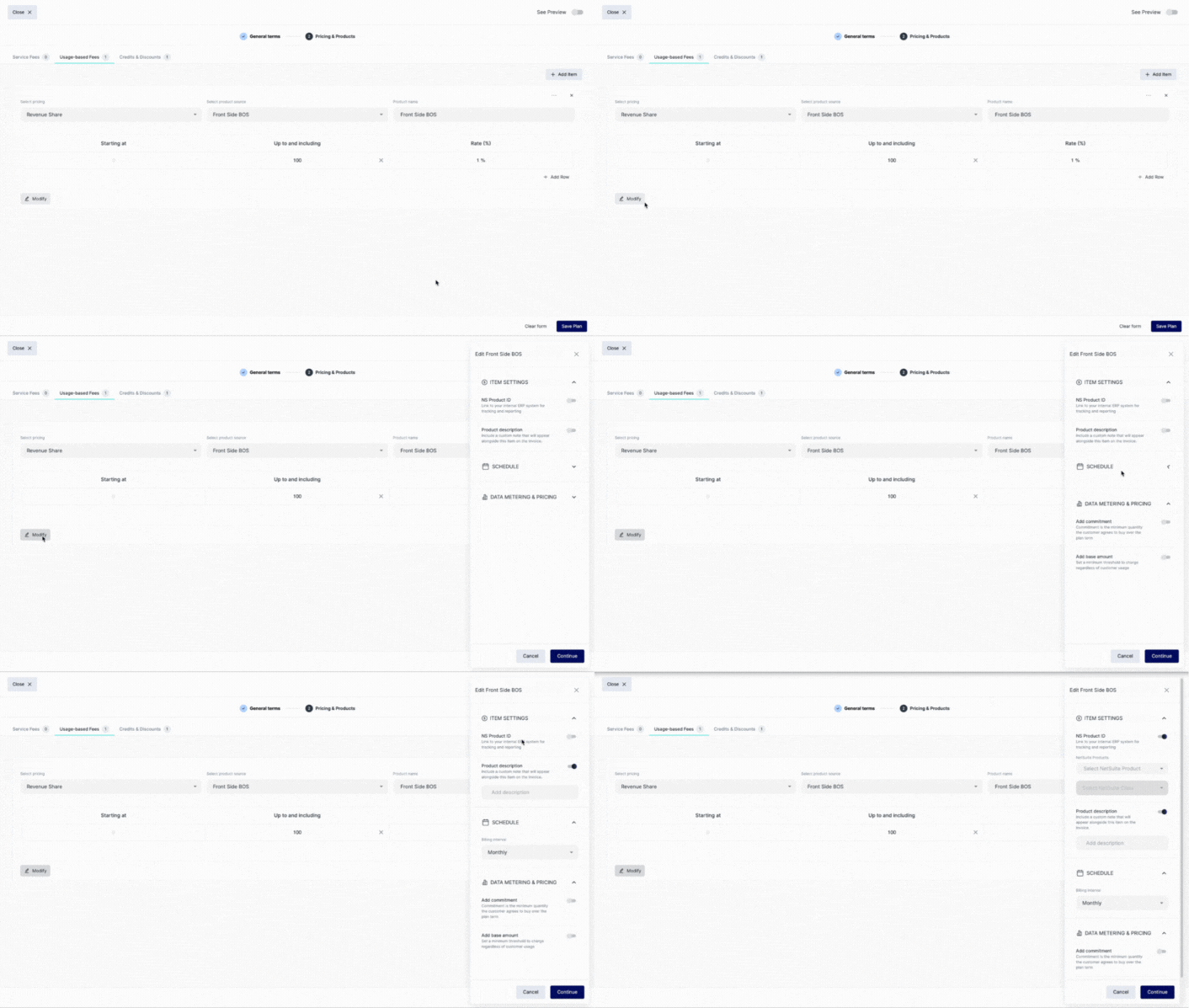
Revenue Sharing is a usage model that charges a percentage of consumed volume for the billing period. It is similar to the volume tier, but in this case the unit price of the revenue share itself is the percentage of the sum of transactions. Similar to standard volume tiers, but the unit price is a percentage of a sum (e.g., total transactions). Customers only pay the percentage in their current tier. Optionally configure a unit cap that applies to each percentage charge (e.g. 0.2% of transaction volume, capped at $5 per transaction). For percentage-based volume pricing, you can optionally set a minimum and a maximum fee threshold. For example, charge 0.5% of every payment event with a $1 minimum and a $10 cap per payment. To edit a Revenue Sharing plan, hit Modify and you can edit the following variables:- NetSuite Product ID
- Product Description
- Schedule
- Data Metering (add commitment/add base amount)
Grouped Products (Bundle)
Grouped products let you take multiple metered products and treat them as if they draw from the same commitment or base amount. In other words, multiple products consume from a shared usage bucket. This can include separate pricing tables for each product. For example, you may purchase a certain number of SMS messages (Product A) or a certain number of WhatsApp messages (Product B) from a provider. If offered as grouped products, an allotment of 2,000 means any combination of SMS and WhatsApp message might be used under the plan.It’s important to note that when there is overage consumption on grouped products, the products will be billed individually according to the respective pricing of each individual product.